Italian Celebrity Chef Lidia Bastianich once remarked: “Italian food really reflects the people. It reflects like a prism that fragments into regions”.
(“Lidia Bastianich Quotes.” BrainyQuote, Xplore ) Italy is steeped in a rich, cultural tradition, with its cuisine being the hallmark of that tradition. Considered to be among one of the finest in the world, Italian cuisine sets the standard for an eating experience like no other. Bastianich states “It’s Italians to live life with a positive tone and to celebrate the invitations that come along in life. Italian food is so conducive to all of that”. Although Italian’s cuisine influence upon the world cannot be denied, similarly the world’s influence upon the evolution of Italian cuisine is equally notable. This equal impact can be seen with a staple of Italian cuisine: Polenta. A dish of boiled cornmeal in its purest form, Polenta is more than an ordinary dish that meets the eye.

What may seem like a simple, ordinary dish actually embodies a rich cultural tradition. The origins of Polenta are rooted firmly in History, dating back to Ancient Roman times. The might and survival of the Roman legions dietary needs was sustained on an early version of the dish called Pulmentum. Wild grains and Farro, a primitive type of wheat, would be mixed with water to form a type of paste, which was then cooked on a hot stone. Pulmentum was served to the Romans as either a type of porridge or hardened into loaves. Eventually, with the arrival of more advanced milling techniques, the Farro would be replaced with Farina, a more thinly grounded variety of wheat. Polenta would exist in this form for many centuries, feeding the masses of poor and destitute citizens who were thus able to sustain themselves on such a simple dish. It’s simplicity, ease of precuring and taste combined to make it a favored meal over bread during Roman times times. Although Polenta remained relatively unchanged, invading Saracens would alter the dish even further with the introduction of buckwheat to Italian peasants during the 10th Century. Called Grano Saraceno by the Italians, this form of Polenta was known to be both delicious and nutritive, and remained popular in Italy until the 16th Century. Tuscany still tempts its many visitors with Grano Saraceno Polenta on the menus of its finer restaurants.

:max_bytes(150000):strip_icc()/GettyImages-183795839-5bf86fd7c9e77c0058dde963.jpg)
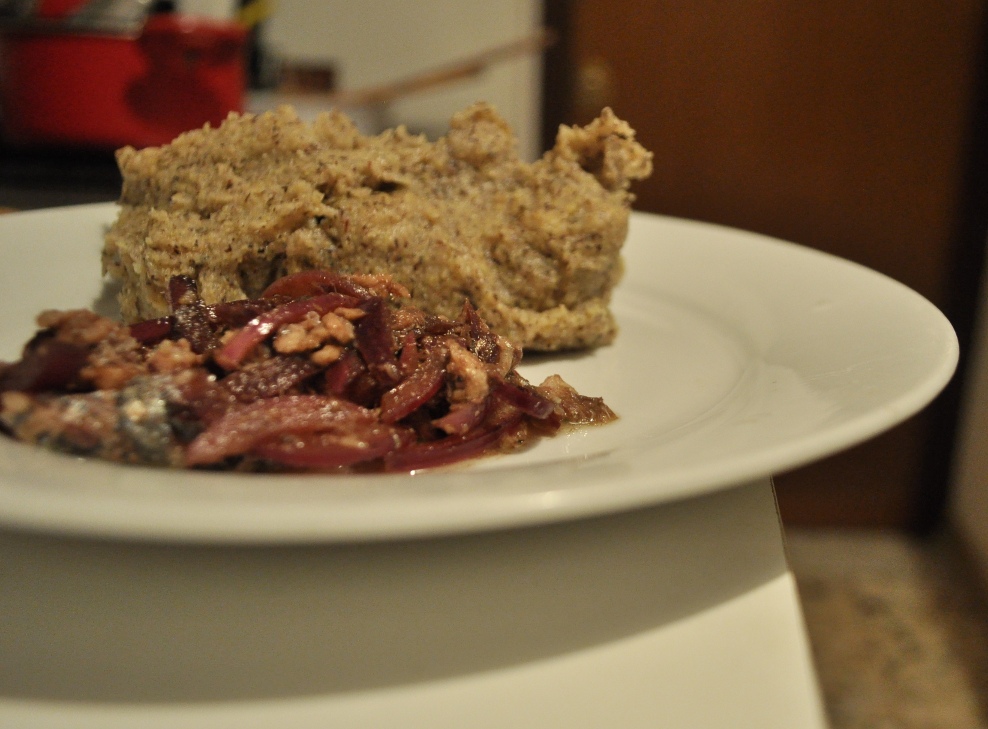
Yet Polenta would be once again forever altered when explorer Christopher Columbus made his landmark discovery in 1492. A crop previously unknown to Italy would very soon alter the shape of its history for the foreseeable future: maize. Italy’s climate was surprisingly well suited to growing the new crop, and it took well to Italian soil. Greedy landlords soon discovered that it was possible to obtain large yields from the crop which in turn allowed them to sell it for a hefty profit which they seized for themselves. Thus, these landlords would force the unlucky peasants who worked for them to grow nothing but acres and acres of corn in the lands of the wealthy landowners.

Deprived of their usual source of food, the peasantry was forced to make do with what they had: cornmeal. They found just as their ancestors had done before that mixing cornmeal into water created a paste that could once again be turned into the staple Polenta. Although not particularly nutritious, this form of Polenta at the very least tasted good and was quite filling, making it a rather attractive option for the peasants. Therefore, Cornmeal Polenta continued to be a staple of mealtimes, particularly in Northern Italy, and continues to do so to this very day. Thus, when poor Italian immigrants arrived in the United States during the 19th and 20th Century, they brought with them the cuisine of their native country. What better a meal for these poor immigrants than Polenta? Northern Italians depended on Polenta to feed their families since it was both abundant and inexpensive. Polenta, introduced in the Unites States during the early 1800’s has remained in the repertoire of Italian cuisine despite its humble origins. The versatility and popularity of the dish has elevated its status to “fine dining”. The nature of Polenta ensures that it can literally be served with an abundance of things, such as sauce, meat, mushrooms or vegetables.

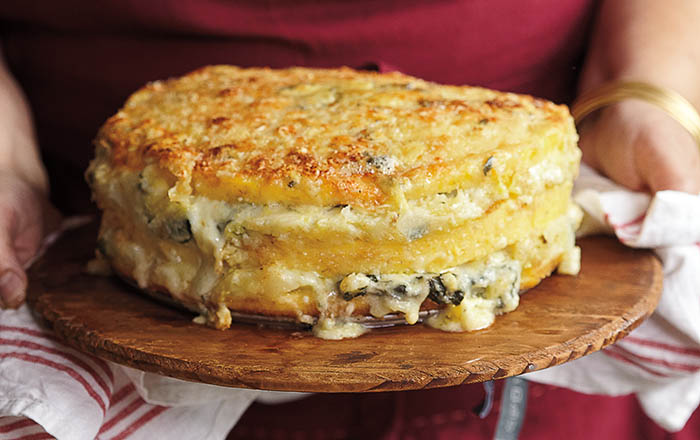

To make Polenta, chefs have found the oldest methods to be the most effective. Traditionally, Polenta is made in round bottom copper pot know as a “Paiolo” and stirred with a long wooden spoon called a “Tarello”. From there, the process is simple but labor intensive: water and cornmeal are added into the pot at a 3 to 1 ratio over a low flame. As the Polenta heats up, it requires constant stirring and attention for upwards of 50 minutes! Although a modern, heavier pot will be less labor intensive, it still requires the chef to keep a watchful eye over it to ensure the right consistency. Once the Polenta has been stirred enough, it can be served as is, as a porridge like substance, or it can be allowed to cool into “blocks” or “bread” and served solid. The chef, or cook, then decides what to garnish the Polenta with: meat, vegetables, or sauce. Instant Polenta is also available for purchase, and it is made much faster with much less effort, but pales in comparison to the “home made” version.

Traditional Italian cookware made specifically for cooking Polenta. It is made of copper
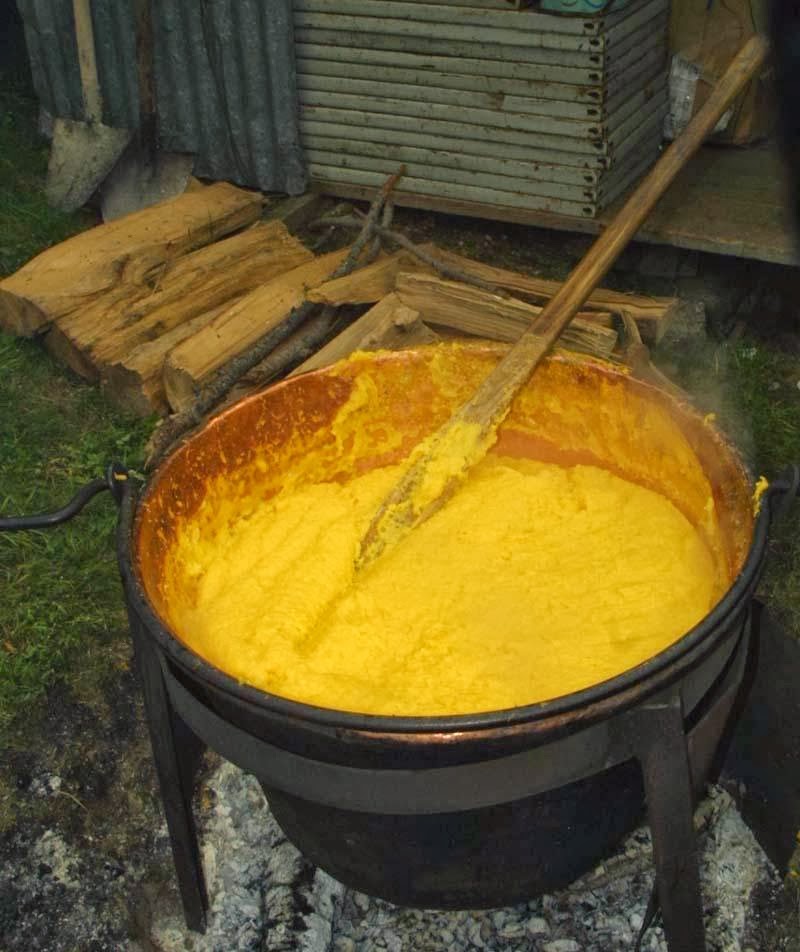
A long wooden spoon used for stirring Polenta
Polenta can no longer be categorized as an entirely Italian dish. Rather, history has shown, the influence it has had upon the evolution of the dish to be a blend of different cultures, throughout different time periods. To quote Bastianich: “Food feeds our souls. It is the single great unifier across all cultures. The table offers a sanctuary and a place to come together for unity and understanding”.

“Lidia Bastianich Quotes.” BrainyQuote, Xplore, http://www.brainyquote.com/authors/lidia_bastianich.
“Polenta.” Life in Italy, 8 Apr. 2019, http://www.lifeinitaly.com/food/polenta.
Jenkins, Nancy Harmon. “POLENTA`S HOT NOW BUT ITS POPULARITY GOES BACK TO 1824.” Chicagotribune.com, 3 Sept. 2018, http://www.chicagotribune.com/news/ct-xpm-1988-04-14-8803080802-story.html.
“The Ancient History of Polenta, The Italian Corn Meal.” ¡Entre Fogones Con Mimi!, 28 Aug. 2016, entrefogonesconmimi.wordpress.com/2013/02/02/the-ancient-history-of-polenta-the-italian-corn-meal/.
 QueensFoodway