- Capatti, Alberto, and Massimo Montanari. Italian Cuisine: a Cultural History. Columbia University, 2003.

When individuals think of Italy, they picture a single, unified country. Yet, this is far from the case, as for the vast majority of its history, Italy was actually a number of separate city states, each one as diverse and different as the rest. Thus, this regionalism plays a significant role in shaping the cuisine of Italy, with citizens from different areas eating rather differently. For example, those in the North have a vastly different diet than those in the South.
The author states in the abstract: “Italy, the country with a hundred cities and a thousand bell towers, is also the country with a hundred cuisines and a thousand recipes. Its great variety of culinary practices reflects a history long dominated by regionalism and political division, and has led to the common conception of Italian food as a mosaic of regional customs rather than a single tradition.”
- “A Model of Historical Development and Future Trends of Italian Cuisine in America.” International Journal of Hospitality Management, Pergamon, 17 Oct. 2009, www.sciencedirect.com/science/article/pii/S0278431909001030#aep-abstract-id8.
The future of the restaurant industry can be a difficult thing to predict. What may be the hottest trend today could easily turn into a flop. This article takes a look at the historical development of Italian cuisine in America as well as what the future holds for the industry. As Italian cuisine is popular within the United States, it is likely that it will have a significant impact on the restaurant industry.
The author states in the abstract: “This study investigated both the historical development and future trends of restaurant cuisine in America.”
- “Reinterpreting Tradition to Innovate: The Case of Italian Haute Cuisine.” Taylor & Francis, www.tandfonline.com/doi/abs/10.1080/13662716.2015.1122512.
While the popularity of Italian cuisine is indisputable, the reasons for its popularity are not as cut and dry. It is based upon several different factors. Italian cuisine continues to innovate even to this day, able to take what may be considered “traditional” dishes and methods and combine them with those from other cultures. Italian food is able to stay relevant and continues to surprise eaters.
As the author states in the abstract: “The present research investigates the development of new products within cultural and creative industries resulting from the use of traditional elements.”
- “Commodified Identities: The Myth of Italian Food in the United States.” SAGE Journals,
https://journals.sagepub.com/doi/abs/10.1177/0196859904267337
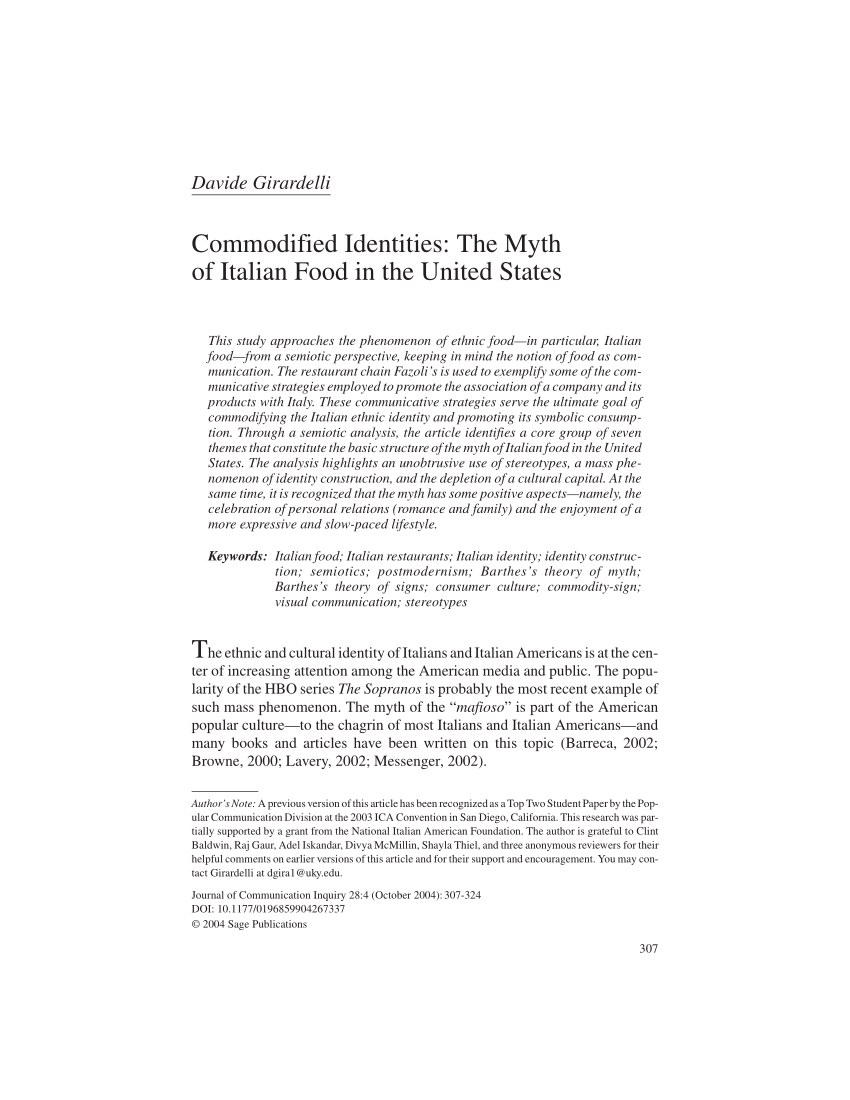
Italian cuisine, just as nearly any other ethnic cuisine, has found itself turned into a commodity. This commodification of the cuisine and its culture employs various strategies to promote itself. It uses communication to associate itself with fine dining. Thus, we are encouraged to go out and buy Italian based products or go eat at Italian restaurants.
As the author states in the abstract: “This study approaches the phenomenon of ethnic food—in particular, Italian food—from a semiotic perspective, keeping in mind the notion of food as communication.”
- Tamburri, Anthony Julian. New Italian Migrations to the United States: Vol. 2: Art and Culture since 1945. Edited by LAURA E. RUBERTO and JOSEPH SCIORRA, University of Illinois Press, 2017. JSTOR, www.jstor.org/stable/10.5406/j.ctt1ws7w5x.
While not directing dealing with Italian cuisine, this source offers the reader a rich and varied history of Italian immigration to the United States, allowing us to better understand the contributions Italians made to society and how they lived out their lives. The reader can infer how their situations would influence what they ate and the ingredients that would be available to them at that time
The author states in the abstract: “This second volume of New Italian Migrations to the United States explores the evolution of art and cultural expressions created by and about Italian immigrants and their descendants since 1945.”
- Black, Rachel E. Porta Palazzo: the Anthropology of an Italian Market. Univ Of Pennsylvania Pr, 2014.

In the age of the supermarket, often overlooked by potential shoppers is the traditional, open air market, where vendors come together to sell their wares. While they still sell food, the primary functions of such institutions have shifted over time, to create more of a social space where tourists and residents alike can come together to chat and spend quality time wit one another.
The author states in the abstract: “Porta Palazzo, arguably Western Europe’s largest open-air market, is a central economic, social, and cultural hub for Italians and migrants in the city of Turin. Open-air markets like Porta Palazzo have existed for centuries in Europe; although their function has changed over time—traditional markets are no longer the primary place to buy food—they remain popular destinations.”
7. Leonard Covello, the Covello Papers, and the History of Eating Habits among Italian Immigrants in New YorkCinotto Simone, Journal of American History, Volume 91, Issue 2, September 2004, Pages 497–521, https://doi.org/10.2307/3660709
This collection of documents give us a firsthand account of the live of Italian immigrants to New York City. The reader us able to see what kinds of food they ate, how they interacted with one another and the type of lives that they lived. They are all direct accounts, coming straight from those who lived through this time period.
As the author states in the abstract: “The Covello Papers is a collection of documents that has abundant source material on the relationship between eating habits and ethnicity in the Italian American community of New York City during the interwar years.”
8. “RECIPE FOR THE NATION: READING ITALIAN HISTORY THROUGH LA SCIENZA IN CUCINA AND LA CUCINA FUTURISTA.” Taylor & Francis, www.tandfonline.com/doi/abs/10.1080/07409710390242372.

This source takes a look at 2 Italian cookbooks and while how on the surface they are merely instruments for cooking, are able to inspire readers to learn about their background and heritage and view it from a different perspective.
As the author states in the abstract: “Today, the relationship between Italian food and Italian identity seems an unremarkable fact. This article explores the history of this relationship by examining and comparing two cookbooks, Pellegrino Artusi’s La scienza in cucina e l’arte di mangiar bene (1891) and Filippo Marinetti’s La cucina futurista (1932).”
 QueensFoodway